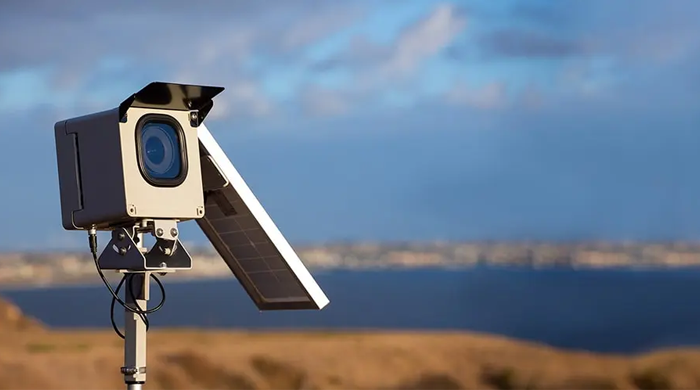
Our time-lapse kit can run continuously for months, even years, with minimal maintenance. It's suited to locations with temperatures between -10 and +40 degrees Celsius. The client can choose to power the kit via a 220V mains cable or via a solar power system, which we can supply on request. Routine and extraordinary maintenance is handled by us, as is the connection and activation of the system.
Over the years we've refined our time-lapse kit. The client only needs to place a concrete pole base at the chosen filming location. We take care of the rest: we install a pole roughly 9 metres tall, to which we fix the camera and the box housing the electronics and, if requested, the solar kit. The cameras can be fitted with different lens formats, allowing recordings ranging from zoom to wide-angle, up to a maximum of 180 degrees. The most commonly used lens captures an angle of around 100 degrees. Motorised lenses are also available on request, though not recommended, since a time-lapse works best when focus and field of view don't change over time.
We provide the client with a dedicated web page, with images captured in real time and an application that can generate a time-lapse on demand, letting you choose the period length (weekly, monthly, yearly) and the start date. Perfect for checking how work progressed during the day or over the past week! If needed, the web page can be protected with password access. Once construction is complete, we remove the kit and produce a high-resolution time-lapse sequence, up to 4K, adding logos, text and music as directed by the client. We also carry out drone footage, which we add at the end of the time-lapse.
The kit is available for rental, and the package includes installation, removal, routine support and time-lapse production. Routine support includes remote monitoring of the kit, on-site checks in case of malfunction, replacement of damaged parts, and battery replacement for the solar kit if depleted. During operation, the camera sends photos to our server at set intervals. Photos are therefore not stored in the on-site box, making the storage of sensitive data more secure and protecting it in the event of theft or other incidents.